"No Compromise OTL Tube Headphone Amplifier"
Andrea Ciuffoli project
Non è un kit
le uniche informazioni disponibili sono illustrate in questa pagina i componenti sono a scelta dal ns sito.
is Not a Kit
all informations available are showed in this Page, components are to choose from our web site
|
This OTL tube headphone amplifier is a more refined design of my previous amplifiers (see A Top-Level Headphone Amplifier). The sound of this version is very "real" and so detailed that you can hear the quality of the source CD player and CD music. Here, I allowed no compromise
to get the best sound for this type of application. It can be used without
any limitation as preamplifier. It can drive any kind of power amplifier
(such as my Power Follower 99), because it has enough output voltage
swing, enough gain (about 30db) and a very low output impedance (about 30
ohms).
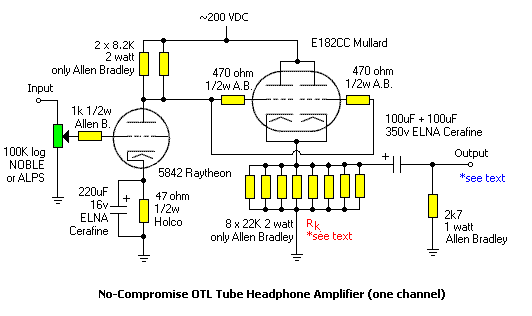
Figure 1 The schematic for one channel of the headphone amplifier is shown in figure 1. Please see A Top-Level Headphone Amplifier for general information about the circuit. The improvements in this version come from the careful selection of parts, the use of tube diodes, and the elimination of the interstage MKP capacitor. Please use only Allen-Bradley, 2W carbon resistors where specified in the schematic. The capacitors must be ELNA Cerafine without any kind of bypass, but the more expensive Black Gate capacitors could be better. I have not tested the Black Gates, but I know (because I have read so in many articles) that the Black Gates need many hours of use before they sound good. It is also necessary to switch on the amplifier every day, or the sound gets bad again. For the class A voltage-gain stage, I tested many tubes, such as the JAN-Philips 5814, the JAN-Philips 5687, the Mullard E182CC, the JAN-Philips 6SN7 and the RCA 3A5 direct-heating twin-triode. I found that the Raytheon 5842 hi-mu triodes had the best sound (JAN-Raytheon 5842WA). It was not necessary to select the tubes. The output stage is a
paralleled-triode cathode follower. For the output tubes, I tried the E182CC
and E288CC and nothing else. I used the Mullard E182CC and suggest only tubes
by Mullard, JAN-Philips or Siemens in the output. The amplifier will drive
headphones of 200 to 600 ohms impedance. For more output to drive 150 ohm
headphones, add another 22K ohm resistor (9) to Rk to increase the
bias current of the E182CC.
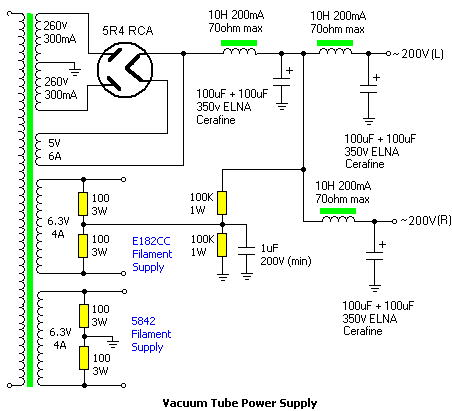
Figure 2 The power supply schematic is shown in figure 2. To get no-compromise performance, the rectification should be vacuum tubes only. I tested the JAN-Philips 5Y3 and the RCA 5R4. I suggest using two 5Y3s or one 5R4, as you like. Only the first capacitor after the diodes could be a normal electrolytic type or better, a paper-oil type. The inductors can have an internal resistance of up to 70 ohms max. and no more!!! I used inductors made by Trau in Italy, and these cost about $23 US. The filament supply is AC, but
I am developing an alternative supply for use in a country like Italy, where
I live and where the voltage goes from 230 volts in the morning to the 196
volts in the evening. In my previous article, I presented a very good DC
filament supply, but in tests, I heard better sound with the AC supply. To
avoid turn-on thumps, wait about 30 seconds after switch-on before connecting
the headphones. I will probably add a time-delay to the audio output, but
integrated with a new regulator for the filament supply.
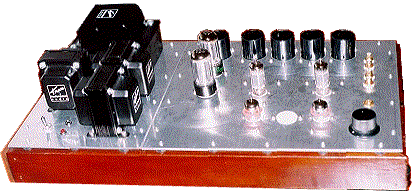
Figure 3 The frame of the chassis is
made of walnut and measures 53cm x 30cm x 5cm. The top is a sheet of 3mm
aluminum. I kept the wood separated from the metal with gaskets placed at the
screw points. All of the audio input and output jacks are gold-plated. The
extra octal tube socket seen in the photograph was for testing a 6SN7 tube.
Addendum 5/17/99: Decreased anode power supply from 280VDC to 190-200VDC to increase lifetime of the tubes and for better sound, removed output capacitor after rectification in power supply to prevent current peaks on the diode and added option to drive 150 ohm headphones. |

Torna all'indice Back to index
Prezzi e prodotti aggiornati sul nuovo sito Audiokit e-Shop cliccando qui !
Update prices & products on new e-Shop Audiokit website click Here
mercoledì 02 luglio 2014