"The SESS Tube Headphone Amplifier"
Andrea Ciuffoli project
Non è un kit
le uniche informazioni disponibili sono illustrate in questa pagina i componenti sono a scelta dal ns sito.
is Not a Kit
all informations available are showed in this Page, components are to choose from our web site
The single tube configuration is the longing of any audio designer, and here we could have only one tube per channel. If we have only one tube on the signal the distortion spectrum will be a perfect decay on all harmonics, so it sounds very natural. We have also no capacitor and no resistance on the signal so nothing can change the characteristic of sound. This project is a single-ended/single-stage/single-tube (SESS) amplifier using the Lundahl LL1630 output transformer, which is gapped for 10mA DC current.

Figure 1
To design a SESS Tube Headphone Amplifier we need a triode with uncommon characteristics: enough voltage gain, low internal resistance and good anodic current. My first test was done with the E182CC (figure 1), but there is the limitation on the usable impedance of headphones in the range of 300 to 600 ohms for maximum performance. The output impedance of the amplifier is about 35 ohms, and I don't accept any damping factor less than 8. (About damping factor: for some, a damping factor of 4 or less is acceptable, but only because they have not heard a better tube headphone amplifier like this one.) The tubes that could be used are E182CC or 5687, but with the 5687, the gain is less. The E182CC is auto-biased to ground through the attenuator. It needs the 1K input resistor for stability, probably because there is no shield on middle of the tube.

Figure 2
This tube has good gain, a very low internal resistance (near 800 ohms) and incredible trasconductance, so it is the final solution to get a very low output impedance to drive headphones from 150 ohms to 600 ohms. This tube also has incredibly low distortion, and the sound characteristic is very natural.
The 5842 version (figure 3) gives a more opened and detailed sound than E182CC
and 6H30 versions, but the big advantage is that the gain is enough to be driven
directly by any CD Player or DAC.
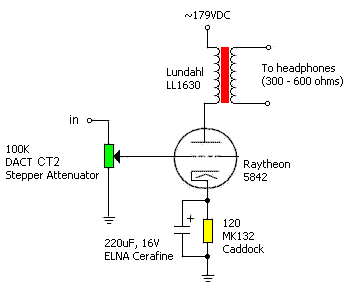
Figure 3
The LL1630 output transformer has a wide frequency response from 10Hz to 40kHz (+/-0.5dB), and a good inductance value to build a perfect headphone amplifier to drive headphones with impedance from 150 to 600 ohms. The LL1630 transformer here is used with parallel connection of the primaries. It must be gapped for a 10mA DC current, so that in parallel connection, it will run fine with the 20mA or less bias current of the output tube. When ordering this component from Lundahl, ask for LL1630/10mA.
The other components are not cheap, and here the highest quality parts must be used to get the maximum result. About passive components types, I don't leave many choices: Holco or Caddock resistances on cathode, ELNA Cerafine or Blackgate capacitors on cathode and power supply, and the DACT or ELMA stepper attenuator. NOBLE or ALPS normal attenuators don't give the same pure sound.
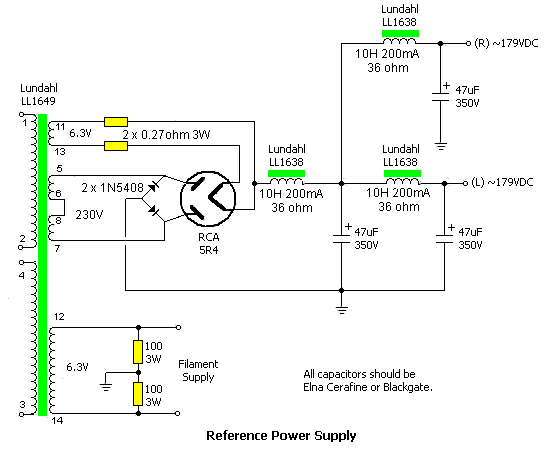
Figure 4
About the power supply, I suggest this Reference Power Supply (figure 4) that gives the best result, but is not very cheap to implement. The 100 ohm resistors across the filament supply are center grounded for low noise. The rectification comes from a Hybrid Graetz Bridge (from a Fulvio Chiappetta article in the italian magazine "Costruire HiFi") made with 1N5408 diodes and a RCA 5R4 rectifier tube. Although it has semiconductors, the sound depends on the rectifier tube, and the switching characterictic is that of the lower speed device - the tube. The hybrid tube bridge has the advantage that it can be driven from a single transformer secondary (the tube rectifier normally needs a dual secondary transformer).
Addendum
2/15/00: Revised figure 2 - changed 1.5K resistor to 820 ohms.
5/1/00: Added figure 3.
Torna all'indice Back to index
Prezzi e prodotti aggiornati sul nuovo sito Audiokit e-Shop cliccando qui !
Update prices & products on new e-Shop Audiokit website click Here
mercoledì 02 luglio 2014