The Ariel Crossover
By Lynn Olson
The Ariel started out with a truly minimal crossover; a 2 uF capacitor in
series with the tweeter, and a 16 ohm resistor in parallel with the tweeter (to
damp variations in tweeter impedance). In theory it should have worked just
fine. It measured very well, as I expected, since the drivers are exceptionally
flat and easy to drive. It just didn't sound very good. It sounded like lots of
other audiophile speakers out there; overetched, unnatural, with a sort of crude
and annoying "look-at-me, don't I have great treble" quality. I played
around with various values for the C and R, but the annoyance-factor stayed the
same. So much for the minimal crossover approach. What's fashionable isn't
always best.
After a while, I realized the source of the problem ... even the most deluxe
dome tweeter doesn't like too much excursion, and that's exactly what a minimal
crossover forces the tweeter to do. All direct-radiators (tweeters, mids,
woofers, etc.) have diaphragm excursion that increases with decreasing frequency
at a rate of 12dB/octave. (Drivers are constant-acceleration devices.) To
prevent the excursion from actually increasing below crossover, you must
use at least a 2nd-order (12dB/Octave) crossover ... even this rate simply keeps
the excursion constant below the crossover point.
I didn't need too much additional persuasion to increase the rolloff rate on
the tweeter; the one-cap crossover also required the tweeter to be connected in
reverse-phase in order to match the midbass units (which have their voice coils
about 1.5" behind the tweeter.) I'm not too fond of drivers wired in
reverse phase ... I prefer to adjust the rolloff rates and other factors so I
can keep all drivers wired in the same polarity. That way the group-delay errors
are only at the crossover frequency, not spread across the entire treble region.
So I reverted to my familiar pattern of designing the crossover to carefully
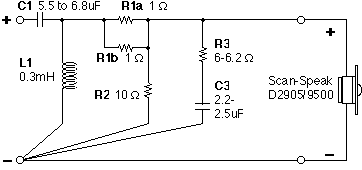
optimize the performance of each driver. The tweeter received a low-Q 2nd-order
network (C1 and L1), a damping resistor in parallel with the tweeter (R2), and
the standard voice-coil inductance compensation (R3 and C3). Much better! That's
what the tweeter wanted all along.
It still needed work, though. The tweeter was fine, but I now could hear the
generic MTM/D'Appolito forwardness from the midrange drivers. That aggressive
and unmusical "home theatre" sound that is so common these days. This
was something I was a little worried about when I started the Ariel project.
Every commercial MTM system I'd heard to date had a forward and rather
unpleasant midrange that was also quite directional ... the snarl didn't really
go away until you walked into another room. I was now hearing it from the
Ariels, and I wasn't too sure I could do anything about it. Time to find out.
Even though the Vifa midbass units measured beautifully flat with a textbook
2nd-order Bessel rolloff, something wasn't quite right. The mids were too
aggressive, smooth MLSSA curves notwithstanding. When you set down the
microphone and actually listened to music and pink-noise, it was quite obvious.
So I took the path of least resistance, thought a little while, and picked a
multi-tapped eptalitz inductor (L5) so I could play around
with the woofer rolloff.
I shut off the tweeters and just listened to the midbass units, adjusting the
tapped inductor as I walked around the room. Much better, but not home free yet.
I picked out several different capacitors and increased the rate to 2nd-order,
starting with a low-Q Bessel slope. The original midrange coloration
disappeared, replaced by a new one about an octave or two higher, near the
corner of the crossover slope. Hmm, what's going on here? Adjusting the filter Q
by changing the C/L ratio didn't fix the problem, so I took the direct approach
and added an R in series with the C6 capacitor. Ah. That sounded good. The MTM
coloration was gone for the first time. How interesting.
Now it was time to have a little fun. I wired a L-pad to 15 feet of cable,
connected it in series with the C, and walked around the room while I turned the
pot. There was a critical value at about 1/3 of the rotation; below that, MTM
coloration, above that, all gone. Turn the pot all the way up, and the mids
reverted to the L-only sound. I repeated this several times, marked the value on
the pot, and measured the resistance. It turned out that 3 ohms was the critical
threshold, so I wired two 6.8 ohm resistors in parallel and left it at that.
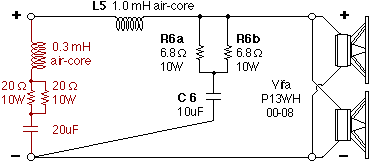
(Looking at the circuit a little more closely, it is evident that R6 and C6 in
the woofer crossover approach a pole-zero cancellation for the woofer
inductance, allowing the main 1.0mH inductor to reshape the response without
interference from the woofer's rise in inductance.)
Now it was time to match up the tweeter crossover, but this was easy, since by now the midbass units had acquired a very gentle 4th-order Gaussian slope ... the way out of the troublesome D'Appolito coloration. I wouldn't have suspected at the beginning of the Ariel project that doing very subtle phase adjustments on the woofer crossover would remove the forwardness in the midrange.
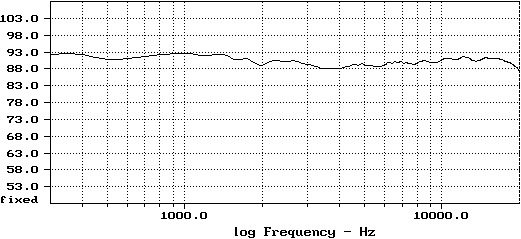
The Ariel now sounded sweet, relaxed, and natural. The 2-meter on-axis measurement (shown above with no response smoothing) followed the intended 2dB slope from 100Hz to 10kHz with a very mild recession around the 3.8kHz crossover region. This is the classic "BBC dip", and much preferable to a "forward" emphasis in the upper midrange. Since ear is approaching its greatest sensitivity in the 2-5kHz region, even very small peaks create an unpleasant and unnatural sibilance. By contrast, a small dip in this region results in a slightly more distant perspective, and a more relaxed sound.
The "BBC dip" is in the most sensitive region of hearing (refer to a Fletcher-Munson curve) and very small adjustments in the value of the tweeter capacitor can "trim" the perspective of the soundstage. If the sound is too "polite" and distant for your personal taste, increase C1 all the way up to 6.8 uF; if it is too forward and "in your face", drop back to 5.5 uF. Whatever you do, please don't use typical metallized-film polypropylenes like Solen for the C1 tweeter cap; I strongly recommend, Hovland, or the VTV or Jensen silver/foil caps as the best choice. Yes, these parts are expensive, but the tweeter cap is the single most important single component in your high-fidelity system - more important than interconnects or speaker wires. Keep your priorities straight!
(For those of you who have instrumentation, you can check your work by intentionally reversing the phase of the tweeter. If the crossover is working properly and you measure at a 2 metre distance, you'll see a 20 to 30dB null at 3.8kHz. This means the phase-match between the normally connected midbass and tweeter is better than 6 degrees, which means the polar pattern is very stable throughout the crossover region. Don't forget to reconnect the tweeter in "normal" phase!)
All that's left is the impedance correction (conjugate) network at the input of the crossover. This isn't audible per se, but some power amps don't like reactive speakers. Without the impedance-correcting network, the impedance rises to about 30 ohms around 2kHz (due to the wide frequency separation between the low and high-pass filters). With the network in place, the impedance rise is limited to 8 ohms. The impedance curve stays between 3.5 ohms and 8 ohms from 10Hz to 100kHz, a simple load for nearly any amplifier. The average value in the 200Hz to 800Hz range is 4.5 ohms, so if you have a tube amp, connect the Ariel to the 4 ohm tap.
The whole process of crossover tuning took about 3 months, checking and
re-checking with MLSSA and LMS each time I tried a slightly different crossover.
15 versions later, I was done, and Karna and I were very glad to settle back and
simply enjoy our new Ariels.
The parts quality of the crossover components has a significant effect on the subjective balance of the speaker, and can easily outweigh re-balancing the crossover or even changing a driver. My experience with the Ariel crossover is that changing an important capacitor or resistor for one of equal value but a different construction requires at least some re-balancing to get the speaker "zeroed-in" again. For this reason, it is essential to use the specified parts (or better ones) for all sections of the crossover.
I strongly recommend, Hovland, or at the most exotic level, Jensen silver/oil capacitors. (I recommend you sit down when you see the prices of silver/oil caps!) Is this kind of big money worth it!? Unfortunately, yes. Capacitors are by far the most colored components in the entire high-fidelity system, and can easily overshadow electronics and even the speaker drivers themselves.
The usual audiophile preoccupation with costly interconnects is almost completely wasted when you consider that many $10,000 audiophile speakers use $5 metallized-polypropylene caps - if $150 had been spent on top-quality tweeter caps, you could save many thousands of dollars elsewhere in the system, and still end up with much better sound. But since consumers don't see the crossover, and don't realize the critical importance of crossover parts quality, they waste thousands of dollars on much less effective system upgrades. (When you buy the tweeter caps, ask for a tested and matched pair ... 1% matching would be nice if possible.)
Even non-polar film capacitors are slightly directional. Ask the vendor which orientation sounds best. Side A will go towards the input, or the signal side of the circuit. Side B will go towards the driver, or the ground side of the circuit. The only reason I can imagine for this phenomenon is that the caps are slightly self-shielding, and little bit of benefit is derived from placing the outermost foil towards the low-potential side of the circuit.
Other crossover parts are important as well, although not as sensitive as caps in the direct signal path. I recommend Jensen or I.T. flat-copper inductors, 10 or gauge air-core inductors, and 10 watt non-inductive wirewound, or 10 W metal oxide resistors.
Warning! Avoid conventional sand-cast power resistors, Mylar or electrolytic capacitors, and ferrite-core inductors. If you use low-quality crossover parts, the sonics of the Ariel and ME2 will be degraded all the way down to mid-fi status. Don't even think about it. On a related note, there are parts vendors who are making their own decisions about Ariel crossover parts without ever having built one; if they try to steer you away from the recommendations on the Web page, run, don't walk, to another vendor. If you're looking for reliable second opinions.
If you want to have fun experimenting with truly exotic parts, such as Teflon or silver-foil oil caps, start with the 5.5 uF to 6.8 uF series cap (C1) in the tweeter circuit, then go after the 10 uF shunt cap (C6) in the woofer circuit. The rule of thumb is that series parts that carry the entire signal are far more audible than components that shunt portions of the audio signal to ground. This rule-of-thumb applies to electronics and volume controls as well, so for components that carry the entire signal, use the very best parts you can get.
The best way to mount the crossover is to give it a box of its own. This
isolates the capacitors from vibration (which they don't like) and lets you
tweak in comfort while you listen. Just keep the crossover at least 12 inches
away from any large iron or steel objects, which means don't put it next to your
power amp or TV set.
Keep the tweeter and midbass filters electrically isolated with independent
star grounds ... also, separate the inductors by at least 6 to 8 inches and
place them at 90 degree angles to each other.
Bi-wiring (independent sets of speaker wires for the tweeter and midbass) is strongly recommended, particularly if the amplifier has a low damping factor (like many tube amps). My initial experiments indicate that single wires sound less dynamic and a bit "flatter" than bi-wire pairs, even if the single wire is quite exotic and costly. This is another area where experimenting can make a real difference to the overall sound of the system.
A Brief Digression about Crossover Design: There is misinformation promoted in some Internet news groups that all you need is the currently fashionable expensive driver and an off-the-shelf active crossover to equal $1,000 to $10,000 commercial designs. This, to be blunt, is just plain wrong. The most exotic and advanced drivers are notoriously hard to integrate into a speaker system, and professional designers know this. The best people in this field take anywhere from 6 to 18 months to design a system that is ready for sale, and that's with years of design experience and daily access to advanced test equipment.
If you found some unusual drivers on eBay, good for you, but now it's up to you to find a professional designer and pay them for their time (I am not volunteering). To give you a idea of what this might cost you, I generally charge US$20/hour for design services, and the Ariel took me 6 months to design (pretty fast for me), so by a quick reckoning that's $20,000 of my time, at least 80% of which was spent refining the crossover. Matching the crossover to the specific drivers in the Ariel took 25 years of experience, $16,000 of hands-on time, and $5,000 of test equipment. That was with drivers that were very easy to work with.
Other drivers, particularly Kevlar, carbon-fiber, Aerogel, or metal, take more time, since they have much more ragged response curves and require significant equalization and phase/polar pattern correction. Every deviation from flatness, especially in the crossover region and above, requires additional design time; sometimes after several months of difficult work, the particular combination of drivers has to be abandoned, and entire speaker system re-thought from scratch. This happens to the best professional designers, not just beginners; every pro, in the more honest moments, will tell you stories about the "the one that got away." Some drivers work together, and others don't.
The individual speaker drivers are not the star of the show; it's the harmonious combination of drivers, crossover, and cabinet that make it all come together. No matter how talented a soloist is, if they can't play with other musicians, they're no good at all. It's the same with speaker drivers. In a very real sense, the crossover is the conductor, responsible for harmonizing a complex dynamic system. That's why buying a generic crossover off the shelf is unlikely to give you the best results.
Since every system sounds different, there are two portions of the crossover which are intended as "user adjustments." The first is the discrete resistor L-Pad (R1 and R2), which raises or lowers the tweeter level, and the second is trimming the value of tweeter capacitor between 5.5 uF and 6.8 uF, which controls the 3kHz presence range. The Ariel crossover is quite sensitive to small variations in component value, so keep your adjustments small and do a lot of listening before making the next change. This is why an easily accessible external crossover is a good idea. When you make changes to the rest of your system, the Ariel can be trimmed to correct for any changes in tonal balance.
If you want maximum treble, leave off R1 and select 16 ohms for R2. If you want a slightly soft treble, select 1 ohm for R1 and 8 ohms for R2. After listening to many different amplifiers over a 2-year period, I chose the middle path of 0.5 ohms for R1 and 10 ohms for R2. The tweeter level is very much up to you, and I expect different people to select different levels depending on their system.
Trimming the value of tweeter capacitor between 5.5 uF and 6.8 uF alters the impression of "forward" vs "distant" sound. (Larger values bring the sound forward.) Transistor amps tend to have a a slightly distant midrange, so 6.8 uF is probably a good starting point. Tube amp owners will probably find 5.5 uF to 6.0uF to be ideal for their system. The goal is for voices to sound natural and "in the room," but without edginess, shouting, or artificiality.
The values above 5.5 uF are especially convenient for combining a 5 uF cap with a smaller, and higher-quality, bypass cap. For example, an interesting combination might be a 5 uF polypropylene film-and-foil paralleled with a 0.5 uF Teflon cap. Avoid combining a cheap metallized-film cap with a more costly metal-foil or oil cap; you can get the worst of both worlds when you do this. The Ariel and ME2 are extremely sensitive to both the value and the parts quality of the tweeter cap; this point cannot be emphasized enough.
As mentioned elsewhere on this Web page, the Ariels are designed for tube amps, not transistor amps; in the four years I've had this site on the Internet, the rare e-mail grumbling about the sonic balance of the Ariel always came from a transistor-amp owner. If your existing speakers need 200 watts to make them sound good, yes, I can see why people buy transistor amps. But if your speakers have more reasonable power requirements, tube amps pretty much win hands down, especially if you include nicely restored vintage amps from Dynaco, Eico, H. H. Scott, or Fisher. A well-restored 1950's amplifier can quite easily hold its own against a $5,000 to $10,000 audiophile tube amp; try it and see for yourself.
Prezzi e prodotti aggiornati sul nuovo sito Audiokit e-Shop cliccando qui !
Update prices & products on new e-Shop Audiokit website click Here
mercoledì 02 luglio 2014