

© Lynn Olson from 1995 through 2001. Permission is granted to Webmasters, readers, and any others to link and mirror these HTML files, along with the associated image files. If you'd like to borrow an image or portions of text from his site.
The Ariel seeks the Middle Path between low-efficiency audiophile speakers and large high-efficiency horn systems. Over the last six years it has evolved and grown in response to feedback from enthusiast builders all over the world. The Ariel has a companion speaker, the ME2, which is simpler to build and is more compact as well. Or maybe you just want to read about high-end speaker design. Whatever your interest, you'll want to warm up the printer and read the Web page at your leisure.
The Ariel
The "Ariel" History, (Version 1 to 6, cabinet design & construction, damping ecc..)
Balancing Sistem ,speaker Location & Image Quality
Efficiency, Amplifiers and Sound Quality
Good Bass sections, Active crossover & positioning
Construction Plan
Mark 3 (second Drawing version)
Diagram & other
The pictures are 144dpi GIF files, and are designed for printing at 50% reduction (a one-step procedure on the Macintosh). If you are using Windows, it's a little more complicated. Right-click the mouse while pointing at the picture. A window will pop-up and ask what you want to do; select "Save As ..." and give the picture a name. You can then "Insert" the saved GIF file into MS Word as a picture file; alternatively, it can be opened in the public-domain LView program or any other graphics program. Either way, the 144dpi GIF image will print at high resolution as a one-page vertical-format picture.
Note: Builders using the metric system should physically measure the speaker drivers instead of converting the fractional inches shown on this diagram. When converting enclosure dimensions to the metric system, start from the interior measurements first ... all other measurements are keyed to the interior dimensions. For example, the rear panel thickness is shown in the drawing as 3/4", but 1", 1.25", or 1.5" would be acceptable, even desirable ... just keep the interior dimensions the same.
ME2 version
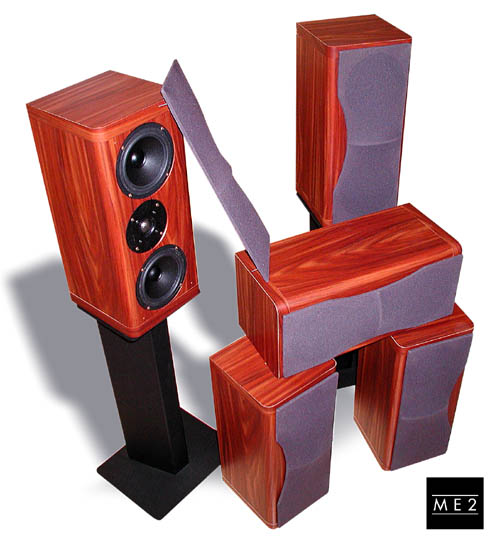
The little brother of the Ariel, with the same drivers and crossover. Simpler cabinet, 20Hz less bass. Midrange is slightly different than the Ariel as a result of smaller interior dimensions and minor vent resonances that occur in all vented-box enclosures. For smaller rooms, especially ones with low ceilings, the ME2's are very likely a better choice than a full-size speaker. What would otherwise be somewhat limited bass in a large room will be nicely filled out in a small room.
2-meter, Nearfield, and 1/3 octave In-Room Frequency Response 18K, 723 x 561 GIF. Print landscape at 75% reduction. The two MLSSA frequency-response graphs are comparable to the graphs published in mass-circulation audio magazines. The upper graph shows the anechoic first-arrival frequency response of the Ariel (the most common type of FR graph), and the lower graph shows a FFT equivalent to a 1/3 octave Real-Time Analyzer (RTA) room response measurement (FFT averaged over 1 second).
MLSSA Impulse and Frequency Response with 6mSec Window 24K, 613 x 1167 GIF. Print portrait at 50% reduction. The MLSSA time, frequency, and 3-D cumulative waterfall responses are comparable to the graphs published in the mass-circulation magazines. These are useful for assessing the time-domain response of a speaker, and the presence of any resonances in the 500Hz to 20kHz region.
MLSSA Impulse and Frequency Response with 2mSec Window 19K, 591 x 1164 GIF. Print portrait at 50% reduction. Shorter window, prettier measurements. Included here just to show how much nicer things get when the window-size is reduced (although part of the improvement is the elimination of a -20dB floor reflection at the 9 mSec marker, just barely visible in the previous impulse response graph).
Ariel and ME2 Crossover & Impedance Correction Network 8K, 488 x 555 GIF. Print portrait at 100%. Not a minimalist crossover, sorry, but the one that sounded the best. This is actually Version 15 ... yes, I built, measured, and auditioned 14 other versions, starting with a minimalist 1-cap, 1-resistor crossover first.
La componentistica per costruire le Ariel è reperibile presso Audiokit
Vista la natura variabile della componentistica, e le esigenze personali di ciascun autocostruttore, non possiamo offrire un vero e proprio KIT di montaggio standard, si prega di scegliere i componenti dal nostro sito Internet, qualora alcuni componenti non dovessero essere presenti, potete richiedere i prezzi tramite e-mail
Prezzi e prodotti aggiornati sul nuovo sito Audiokit e-Shop cliccando qui !
Update prices & products on new e-Shop Audiokit website click Here
Torna all'indice generale progetti - Back to general projects index
mercoledì 02 luglio 2014