Ariel
By Lynn Olson
If you're contemplating deep and natural-sounding bass for the Ariel or ME2, steer clear of the 10" to 15" poly-cone subwoofers that are so common these days.
The first reason? Polypropylene simply isn't a very rigid material; it isn't much more rigid than Tupperware (tm), and can easily have that characteristic "plastic" sound when it is used for cones larger than 8 inches. The "give" of the soft cone results in higher IM distortion than stiffer cone materials like treated paper, Kevlar, or carbon-fiber/paper composites. There's a good reason you don't see polypropylene used in load-bearing applications; it begins to "creep" and deform at fairly low values of mechnical stress. Treated paper, Kevlar, and carbon-fiber behave differently, and tend to be rigid up to the point of deformation. This translates into low-distortion up to the point of "cone cry", when the cone material enters breakup modes. By comparison, polypropylene flexes even at moderate levels of acceleration. This smooths the frequency response at the expense of increased distortion.
The second reason? Most well-reviewed "audiophile" drivers have magnetic circuits that are no better than consumer-grade; it just isn't a priority, since hi-fi magazines don't care much about IM distortion in speakers. In the real world, though, IM distortion is a very important consideration. Few bass drivers have magnet systems optimized for low IM distortion; the only ones I know of are expensive professional studio monitor drivers from JBL, Altec, and TAD, and the Scan-Speak drivers for consumer use. The Scan-Speaks aren't exactly cheap either, but they cost a lot less than the $350 to $800 retail price for prosound drivers.
(If you want the ultimate and are not deterred by cost, size, or weight, check out Stig Erik Tangen's Almighty Subwoofers page, which features a 15" JBL 2226G in a massive 220 litre 160kg sand-loaded enclosure. Point your browser to: http://www.speakerbuilding.com/amateur/tangen_sub2.html)
When it comes to bass, the perception of "speed" has only moderate correlation with overall transient response, and a great deal to do with low IM distortion and freedom from stored energy in the cone or cabinet. This is perceived as resolution, tactility, or "slam," and is the hallmark sound of electrostatic and full-range horn systems. Even though electrostats are famous for near-perfect impulse response, and horns for so-so impulse response, both types share remarkably low IM distortion in comparison with conventional dynamic drivers.
If you want a direct-radiator woofer to have that kind of "snap" and presence, seek out drivers with stiff cones and low IM distortion. (By the way, long excursion "specs" no more guarantee low distortion than high power amplifiers assure good sound. Quantity and quality are not the same thing.)
Where to start? some interesting new drivers from Scan-Speak, all with carbon-fiber/paper cones and the SD-1 low-distortion magnet system. The four drivers and the factory-recommended enclosures are:
|
Scan-Speak |
Size |
F3 in Closed Box |
F3 in Vented Box |
|
21W/8555 |
8" |
45Hz in closed 34L |
35Hz in 50L vented |
|
21W/8555-01 |
8" |
50Hz in closed 24L |
35Hz in 34L vented |
|
25W/8565 |
10" |
34Hz in closed 100L |
N/A for vented |
|
25W/8565-01 |
10" |
38Hz in closed 76L |
25 Hz in 100L vented |
For those who are familiar with Thiele/Small driver models, the specified parameters of these four drivers are:
|
Scan-Speak |
Efficiency |
Fs |
Vas |
Qms |
Qes |
Qts |
|
21W/8555 |
87 dB |
20 Hz |
145 L |
4.61 |
0.33 |
0.31 |
|
21W/8555-01 |
87.5 dB |
19 Hz |
145 L |
4.97 |
0.28 |
0.27 |
|
25W/8565 |
87.5 dB |
20 Hz |
222 L |
5.65 |
0.45 |
0.42 |
|
25W/8565-01 |
88 dB |
19 Hz |
222 L |
5.91 |
0.38 |
0.35 |
Although a single 25W/8565-01 10" driver in a 100 litre vented system is appealing (especially with an F3 of 25Hz), I'm drawn towards something a little more unusual, a pair of 25W/8565-01 drivers facing away from each other in a 100 litre closed-box cabinet. The face-to-face mounting cancels the reaction forces coming from the woofer cones, greatly decreasing both vibration within the cabinet and vibration transmitted to the floor. Depending on driver matching, the spurious mechanical noise transmitted to the floor can be reduced 20dB or more, a considerable improvement.
With a closed-box system and efficient coupling to the floor boundary, room lift can provide a free half-octave of bass extension. Although vented alignments certainly provide a lower F3 and lower distortion in the 30-40Hz region, the steeper rolloff of vented systems means they don't quite match the gentle 1st-order slope of room lift. (As frequencies get lower and wavelengths get longer, you enter the region where they are larger than the room itself. This is the region of room lift, where the entire room transitions into a single near-field listening environment.)
I would suggest placing the lower edge of the woofer cone as close as possible to the floor to optimize coupling to the floor boundary. If the driver is more than a few inches away from the floor, the coupling is greatly decreased, and driver has to work much harder. Getting the rim of the woofer as close as possible to the plane of the floor optimizes the coupling into the floor boundary in the same way as a pressure-zone (PZM) microphone.
To further improve coupling to the floor boundary, I'd also suggest a rigid base plate extending four to six inches directly in front of the drivers. This allows the acoustic energy coming from the cones to spread out and decrease in pressure before it encounters absorption losses from the carpet (again, similar to the base plate of a PZM microphone). By screwing the rigid base plate into the woofer cabinet, you can stiffen the enclosure and improve room coupling at the same time.
If the cabinet is lightly filled with polyester fiberfill (recommended), the physical volume can be decreased 15%, yielding an 87 litre cabinet, or 5326 cubic inches. In practice you'll need to allow for the space taken by the reinforcing elements, so that adds another 3 litres or 200 cubic inches back again, so 90 litres or 5500 cubic inches is a good starting point for the cabinet volume. The next question is the most favorable ratio of width, depth, and height, which isn't quite as simple as it first appears.
The two woofers facing each other have implications for standing-wave modes inside the cabinet; in effect, the "width" dimension is cut in half, since the woofers facing each other behave exactly as if there were an internal partition on the centerline. As far as standing-wave modes go, the mode related to "width" dimension becomes one-half of what it would be if there were just one woofer.
Standing-waves are driven most strongly when the driver is close to a interior boundary, and for this design, this is true for the "width" dimension and the "height" dimension. If you want to place the woofer against the rear wall of the room, this is true for the "depth" dimension as well. The only way to smooth out the standing waves inside the cabinet is to choose the golden section ratios used elsewhere in the Ariel. These ratios are:
|
1.000 |
1.618 |
2.618 |
4.236 |
6.853 |
As far as cabinet modes go, the effective "width" dimension is half the physical dimension, so if we choose 1 : 1.618 : 2.618 ratios, the "virtual" dimensions are: 8.75" wide, 14.25" deep, and 23" high. However, these dimensions only apply to the mode-calculation; the actual physical dimensions are 17.5 by 14.25 by 23 inches.
To calculate the interior volume, use the recommended physical dimensions of: 17.5" wide, 14.25" deep, and 23" high, for a net volume of 5735 cubic inches. If you build the cabinet out of 3/4" plywood, this provides exterior dimensions of: 19" wide, 15.75" deep, and 24.5" high. If you choose thicker plywood, increase the exterior dimensions accordingly. Note: Don't be fooled by the illustrations shown below; use the actual recommended dimensions to create your drawings for the woofer cabinets.
(If you want to build a cabinet for a single Scan-Speak driver, like the 100 litre vented system, you can skip the "virtual" business and just select a set of interior measurements that follow the recommended 1 : 1.618 : 2.618 ratios.)
With interior dimensions of 17.5" W, 14.25" D, and 23" H, and the two woofers facing each other, there are quarter-wave and three-quarter-wave nulls at 147, 238, 387, 441, 713, and 1160Hz. There are also half-wave and full-wave peaks at 294, 475, 588, 774, 950, and 1548Hz. At higher frequencies the fiberfill damping gradually becomes more effective, so the peaks and nulls above 300 Hz are not too serious. On the other hand, the first nulls at 147 and 238Hz, and the first peak at 294Hz, need to be controlled by some additional damping materials.
Putting a layer of Deflex on the inside top surface of the cabinet will attenuate the 147Hz null and 294Hz peak, and quiet down the top panel as well. Another layer of Deflex on the inside back surface of the cabinet will absorb the 238Hz null and 475Hz peak. Regardless of how you build your cabinet, the most important location for the Deflex damping pads are the two interior surfaces that are farthest from the driver; it is these two reflective surfaces that create standing-wave modes at the lowest and most difficult-to-control frequencies.
Now that standing-waves are dealt with, there is still the issue of cabinet rigidity. The best way to stiffen the entire cabinet is use two horizontal crossbraces that span the entire width and depth of the cabinet; if you want to stiffen the top panel, you can add a vertical crossbrace as well. To allow the internal sections to acoustically communicate with each other, cut a random assortment of circular openings in the crossbraces, ranging in size from 2 to 5 inches across.
In the deep bass range, cabinet damping is less important than sheer rigidity. Cabinet-wall resonances typically occur between 300 to 800Hz, well above the recommended crossover frequency. Since the self-damping properties of MDF are not required in a woofer cabinet, a stiffer and more rigid material like plywood is a better choice. (Apple-Ply or Baltic Birch are the best grades of plywood for speaker cabinets.) Since plywood has a much higher speed of sound than MDF, the panel resonances will also occur at a higher frequency than MDF, which is desirable in a woofer cabinet (but not in a 2-way system where the midbass goes up to 3 to 4kHz.)
Consider 3/4" engineering-grade (no voids) plywood a reasonable minimum; 1" for the panels that carry the woofers is a good idea, and 1" for all exterior panels certainly isn't overdoing it. For the interior crossbraces, 3/4" should be adequate.
Mechanically gifted builders who aren't afraid of the exotic might consider brass or stainless-steel threaded rods to couple the two woofers together. I've heard about people doing this, but I haven't tried it myself. If anybody tries these unusual construction techniques, let me know how it works out!
Going back to the Theile/Small math, a 2-woofer 100-litre system has a Qtc = 0.77, with an F3 = 39Hz. This is a 2nd-order rolloff with moderate Q, and room lift is coming into play, so 25 to 30Hz will be clearly audible. If you would like slightly better transient response, increase the cabinet volume by 20 to 30%; if you want slightly lower distortion, decrease the volume by the same amount. The alignments for best transient response (Qtc = 0.57, very large cabinet) have poor IM distortion, and the alignments for lowest IM distortion (Qtc = 1.1, small cabinet) have poor transient response.
The choice between the best transient response and the lowest-distortion alignment is one of the most important findings of Theile/Small theory, much to the dismay of marketers everywhere. Like other aspects of the Ariel, I've walked a middle path on this one.
No matter which alignment you choose, the high efficiency of this system (91 dB for one watt, and 94dB for 2.83V), large cone area, and the reflected image off the floor assure low IM distortion. If you do the right thing and build a stereo pair, the effective cone area (including the reflected floor image) is equal to eight 10-inch woofers.
Close examination of the frequency response curves of the new Scan-Speak drivers shows that we have to be a little careful with the crossover. The carbon-fiber cones are very stiff all right (delivering crisp bass), but like most other rigid cones, there's a good-sized peak in the midrange. For the 8" driver, it is around 3.1kHz, and for the 10" driver, it is around 2.4kHz. Since the midrange peak is 8 to 10dB high for all four drivers, it's obvious that they were never meant for 2-way systems. These are bass drivers!
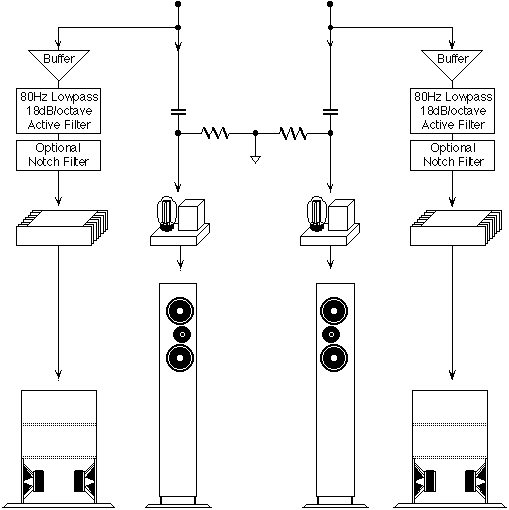
You might be thinking that since we're planning on a crossover around 80Hz, there's nothing to worry about. Don't. My first speaker system, the Audionics TLM-200, used the KEF B-139 expanded-foam bass driver, which has a big peak around 1.5kHz. Even with a 12dB/octave 160Hz crossover, I could still hear the forwardness of the KEF B-139, even though the peak was being attenuated by a good 30 to 35dB by the time we got to 1.5kHz. It took a third-order crossover to remove it from audibility; that moved the peak 50dB down from the rest of the system response.
The same situation applies to the Scan-Speak carbon-fiber woofers; even though the intended crossover is 80Hz, I would advise a 3rd-order (18dB/octave) active lowpass filter for the bass drivers. At 80Hz, you can forget about passive crossovers; this is bi-amping territory. Fortunately, we don't have to worry about sonic degradation due to op-amps or solid-state in this frequency range. Solid-state really comes into its own once you don't ask it to handle any high frequencies.
If you really want to travel first class, measure the midrange peak with the driver in the intended enclosure, and remove it with an active notch filter. That way you can use a separate 2nd or 3rd-order active lowpass filter, and use any crossover frequency without fear of the midrange peak messing up things. A low-frequency signal path consisting of a buffer, a low-pass filter, a notch filter, and a solid-state bass amp is sonically benign; lows are easy for solid-state, but difficult for tubes. (Read all about op-amp filter design in the "IC Op-Amp Cookbook" by Walt Jung.
The task of the high-pass filter is much simpler; all it does is remove low-frequency energy from the high-frequency amplifier and the Vifa midbass drivers. If you're using tube amps for the Ariel and ME2, the benefit of the filter is even greater, since LF energy is the primary source of distortion in output transformers. (This is true regardless whether or not you use a single-ended or push-pull vacuum-tube amp.)
One capacitor at the input of the high-frequency amp (followed by a 100K resistor to ground) is all it takes to roll off the lows. With only one capacitor in the signal path, you are free to explore exotic parts like Teflon, polystyrene, copper-foil oil caps, etc. The simple 6dB/octave filter at 80Hz allows amplifiers with EL84's, 2A3's, or 300B's to sing their sweetest, since they no longer have to handle a part of the spectrum they'd rather not deal with anyway. The transistor amp does the heavy lifting in the DC to 80Hz range, where considerations of Class A, Class AB, TIM distortion, and feedback topology are less important than at higher frequencies.
Stereo woofers are the way to go, but not for the reasons described in
the hi-fi magazines. It is true that localization is very difficult to perceive
when the wavelengths are longer than 10 feet. However, there is an effect known
as "Spatial Impression," which conveys the impression of size, or
space, and it is quite important at very low frequencies. A mono subwoofer, in
other words, won't distort the image, but it won't sound as spacious as stereo
subwoofers! In addition, it has been discovered in psychoacoustic research that
a 2-speaker stereo image grows narrower as the frequency is decreased ... which
means that it's a good idea to place the stereo woofers well outside the normal
stereo-pair, so the image retains its width and "air" over the full
musical spectrum.
There are three interesting options when it comes to the front-to-back location of the stereo woofers, with a distinctive set of advantages and disadvantages for each one. Note that both the highboy and lowboy woofer orientations are shown; when you build the woofer, it might be a good idea to provide an option for the base plate to screw into either orientation, so you can decide which way sounds best for you. Of course, if you have a bare stone floor, you won't need a base plate, but you will need socks to keep your feet warm ...
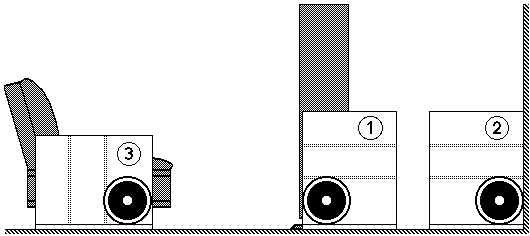
- The simplest and most direct choice for most people. By flanking the
Ariels
or ME2's, the woofers are close to coincident with the high-frequency drivers,
greatly simplifying the crossover phasing and allowing the option of
linear-phase performance in the low-frequency region. (This would require a
2nd or 3rd-order Bessel filter and a 2.4kHz notch filter for the active
crossover.)
- For cave-dwellers who have brick, concrete-block, or concrete walls behind
the speakers, you have the option of exploring the Roy Allison 1/4pi bass
loading system. Since carbon-fiber woofers have near-perfect piston-band
performance, you can even try the Allison-recommended 200 to 300Hz crossover
... just remember to include the notch filter, so the carbon-fiber peak at
2.4kHz doesn't sneak through. For those who demand flat response in the 100 to
400Hz region, the Allison bass loading is the way to go.
The tricky part is getting the crossover phasing right. There's a path length difference of at least a meter, or 2.9 mSec. Since it is easy to delay bass (just cascade Bessel low-pass filters), but very difficult to delay the highs, there is no option of linear-phase performance unless you use signal processing in the digital domain. This means a conventional (non-digital) crossover will inevitably have at least 3mSec or more of group delay variation in the lower-midrange/upper bass region, and the woofer may or may not be in phase with the high-frequency drivers, depending on the crossover slope. If you can live with a bit of phase rotation and crossover tuning, the Allison 1/4pi bass loading will give you a radiating area equal to sixteen 10-inch woofers!
- Putting the woofers on the left and right sides of the couch might seem
like a weird borrowing from the boom-boom autosound people, but it's not.
Think of this as near-field bass. Instead of filling the entire room, the
listener is in the near-field over the entire passband of the woofer. This
provides two important advantages: the room doesn't get to screw up the bass
response, and better yet, the requirement for woofer excursion and amplifier
power is greatly decreased, since the system is really just a big open-air
headphone.
What about the path-length differences mentioned in Example 2? For this example, the path-length difference is even bigger; typically between 1.5 and 2.5 meters (4.4 to 7.3 mSec). In this case, though, it's the bass that needs the delay, not the highs, and that makes all the difference. A cascade of Bessel low-pass filters provide a convenient way of providing uniform delay with frequency (this doesn't happen with the Bessel high-pass filters, unfortunately). If you're smart enough to do the math on the active Bessel low-pass filter, you can equalize the path-length difference, provide a linear-phase crossover in the bass region, and remove room interaction all at a once! (But don't pester me about the filter design; that's up to you.)
Prezzi e prodotti aggiornati sul nuovo sito Audiokit e-Shop cliccando qui !
Update prices & products on new e-Shop Audiokit website click Here
mercoledì 02 luglio 2014