Ariel ME2 Version
By Lynn Olson
Over time, several Positive
Feedback readers asked me about a simpler and more compact version of the Ariels.
After thinking about it a while, I started up the LEAP speaker modelling program
and took a look at the various options for the Vifa midbass driver. The closed
box was out; F3 was an absurd 110Hz or so. The only remaining option was a
vented box, in order to get the F3 into a halfway reasonable region.
The tradeoff with all vented boxes, of course, is a degree of impulse
response overshoot in return for a much lower F3 point. At very low frequencies,
this overshoot isn't a major problem, since it merges with the standing waves in
the room itself. But at the 83Hz frequency that results from the standard QB3
vented alignment, the time-domain overshoot starts to become more audible, since
it is not masked by room modes (except in very small rooms).
 I
wanted something a bit more elegant than the standard QB3 alignment, so I looked
up the Audio Engineering Society articles by Richard Small in 1973, and went
through the math for a fourth-order Bessel alignment. Unlike low-pass filters,
high-pass Bessel filters do have overshoots - but they are smaller than the
generic Butterworth/QB3 alignments that are typically used for vented speakers.
If you want the least possible overshoot and group delay variation for a vented
enclosure, the Bessel is the one to choose. The alignment also has a subtle
advantage in being less sensitive to dynamic variations in driver Qt compared to
conventional alignments.
I
wanted something a bit more elegant than the standard QB3 alignment, so I looked
up the Audio Engineering Society articles by Richard Small in 1973, and went
through the math for a fourth-order Bessel alignment. Unlike low-pass filters,
high-pass Bessel filters do have overshoots - but they are smaller than the
generic Butterworth/QB3 alignments that are typically used for vented speakers.
If you want the least possible overshoot and group delay variation for a vented
enclosure, the Bessel is the one to choose. The alignment also has a subtle
advantage in being less sensitive to dynamic variations in driver Qt compared to
conventional alignments.
Since Bessel alignments aren't part of the default family of alignments
prepackaged with the LEAP simulator, it took a bit of experimenting, but
eventually I got the response curves I was looking for. With the volume and vent
dimensions provided courtesy of LEAP, it was a simple matter of sketching out a
compact enclosure with the vent apertures hidden away from the direct line of
sight of the Vifa drivers. When my sweetie saw the drawings and the petite
dimensions of the new speaker, she suggested calling them the ME-2 (pronounced me-too).
Why not? So ME2 it is.
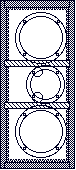
The ME2 speakers are 18" high, 8" wide, and 8.5" deep, with an
internal volume of 521 cubic inches, and a pair of 1" diameter vents that
are 4.125" long. Everything else is the same as the transmission-line
Ariels; same drivers, crossover, front panel layout, composite MDF/plywood
construction, etc.
Since the ME2 is intended for connection to vacuum-tube amps, it is designed
for modest damping factors of 4 or higher. For SE triode amp designers, that
means the primary impedance of the output transformer should be at least 4 times
higher than the Rp of the output tube. (The 2A3 and 300B have an Rp around 750
ohms; this means a primary of 3K or higher would be desirable.)
The LEAP modeling system shows a -3 dB point of 70 Hz, a -6 dB point of 53
Hz, and a box tuning frequency of 48 Hz. Your initial reaction might be: 70Hz!
That's not a lot of bass! Well, actually, it's not too different than lots
of other minimonitors ... many of them are actually spec'ed at the -6dB point,
which gives a better match to the perceived low-frequency limit.
Still, I agree, you're not going to make the room shake with 521 cubic inch
speakers. The ME2 is aimed at three groups: folks who like the unadorned
minimonitor sound, those with multichannel systems, and/or systems that use two
biamplified woofers.
The drawings pretty much tell the tale. Use Baltic Birch or Apple-Ply plywood
for the internal members, and premium-grade MDF for the outer shell. The
1.5" thick front panel plays a significant role in quieting down the
cabinet and is worth the hassle of bonding two 0.75" panels together. Be
sure to make the speaker in mirror-imaged pairs and try to achieve the
1.25" radius shown on the drawings ... I found out that there is a pretty
big sonic difference between 0.75" and 1.25" radius when I made the
Version 1 and Version 2 Ariels.
Lightly fill the V-shaped rear half of the cabinet with long-fiber wool (best
for mids) or crimped Fortrel (like Acousta-Stuf), but don't cover the
inlets of the vent tubes.
Note: If you're using the ME2 with woofers, fill the vents with
wool or Fortrel. This improves the clarity of midrange (by stopping the mids
from coming out of the vents) and damps the low-frequency cone motion of the ME2
drivers, which further improves the midrange clarity by keeping the voice-coil
in its most linear region.
You'll notice that there isn't any room inside the cabinet for a crossover
... that's intentional, since vibration of crossover components can degrade the
clarity of sound. A small external box for the crossover is the best solution
... but keep it at least 12" away from steel stands and transformers. When
you lay out the crossover, remember to keep the inductors at least 8" away
from each other, and to place them at right angles to each other as well.
Crosstalk between the inductors, or any adjacent ferrous objects, will seriously
degrade the sound and possibly even affect the reliability of the drivers.
I recommend placing the ME2's at the tips of an equilateral triangle with
your listening position at the bottom of the triangle. Aim them at a point about
1 foot in front of you, with the tweeters on the inside of the stereo pair. You
should be able to see just a little of the side of the cabinet that has the
large radius.
Next, adjust the height of the stand so the centerline of the tweeter is
between 38" and 40" high. If the tweeter is below ear level, the
stability and overall size of the stereo image will be degraded, so adjust the
height so the tweeter is at or a few inches above ear level. (Many compact
speakers that "sound bad" can be cured simply by elevating the tweeter
to ear level! This is a psychoacoustic effect that doesn't appear in any
measurement.)
When the ME2's are correctly set up and used with the right electronics, they
will have a very big, spacious sound, a stable stereo panorama well off-axis,
and will sound quite natural and lifelike even from another room. They are
"tuned" for the best possible voice reproduction, so use recordings of
male and female singers to do the final in-room tuning with crossover levels,
cables, damping material, location from the back wall, etc.
Part of the reason I designed the ME2 was listening to the Cogent Research
SPI, which is a modern sum-and-difference 4-channel decoder using
psychoacoustically optimum decoding coefficients (whew!) This unit offers
high-resolution "frontal quad" without the listening fatigue that most
people associate home theatre systems.
My preliminary listen to the Cogent showed a lot of promise ... very wide and
spacious soundstage, stable imaging, with reasonable but not great sound. But I
listened to the Cogent unit with a quad mid-fi Rotel amp and four mid-fi
speakers at $300 each. Comparing this setup to the two Ariels and the resident
triode amp was ludicrously unfair ... there was a ten-to-one difference in price
against the Cogent setup!
Which is where the ME2's come in. They have the same phase and frequency response as their bigger brother, so they can be mixed-and-matched in a multichannel system. The Ariels and ME2's have identical radiation patterns, as well as identical crossovers. The close symmetry assures an even soundfield from front-to-rear, which is a property of the soundfields we encounter in the real world.
After all, what was the last time you heard a real-world environment with dry, cold, no-reverb sound in the front, and a formless wash of diffusion to the sides and rear? As silly as it sounds, this is the underlying design metaphor for home theatre, and the reason for the high fatigue when you try to play music through a fundamentally unrealistic system.
With music, the deformation in acoustical perspective is so obvious that
eventually the ear, brain, and mind shout "I give up!" and the
listener experiences an acute desire to turn the thing off in self-defense.
Before you write off multichannel altogether, give it a try with the same
philosophy that has been taken for granted in stereo for 40 years; identical
electronics of high quality, and precise matching for radiation pattern,
crossover phase, and frequency response in the loudspeakers. You might be
surprised!
Prezzi e prodotti aggiornati sul nuovo sito Audiokit e-Shop cliccando qui !
Update prices & products on new e-Shop Audiokit website click Here
mercoledì 02 luglio 2014